// CASE STUDY · EDTECH
AlpasGrade: close the term in an afternoon
A grade management system for Filipino class advisers and subject teachers. It turns quarterly spreadsheets and hand-typed report cards into one guided workflow.
- Product
- Barehacks' own
- Type
- Web app (SaaS)
- Audience
- DepEd public and private school teachers
- Pricing model
- ₱499 per section per year
- Website
- alpasgrade.com
THE PROBLEM
Every grading period, teachers rebuild the same spreadsheet.
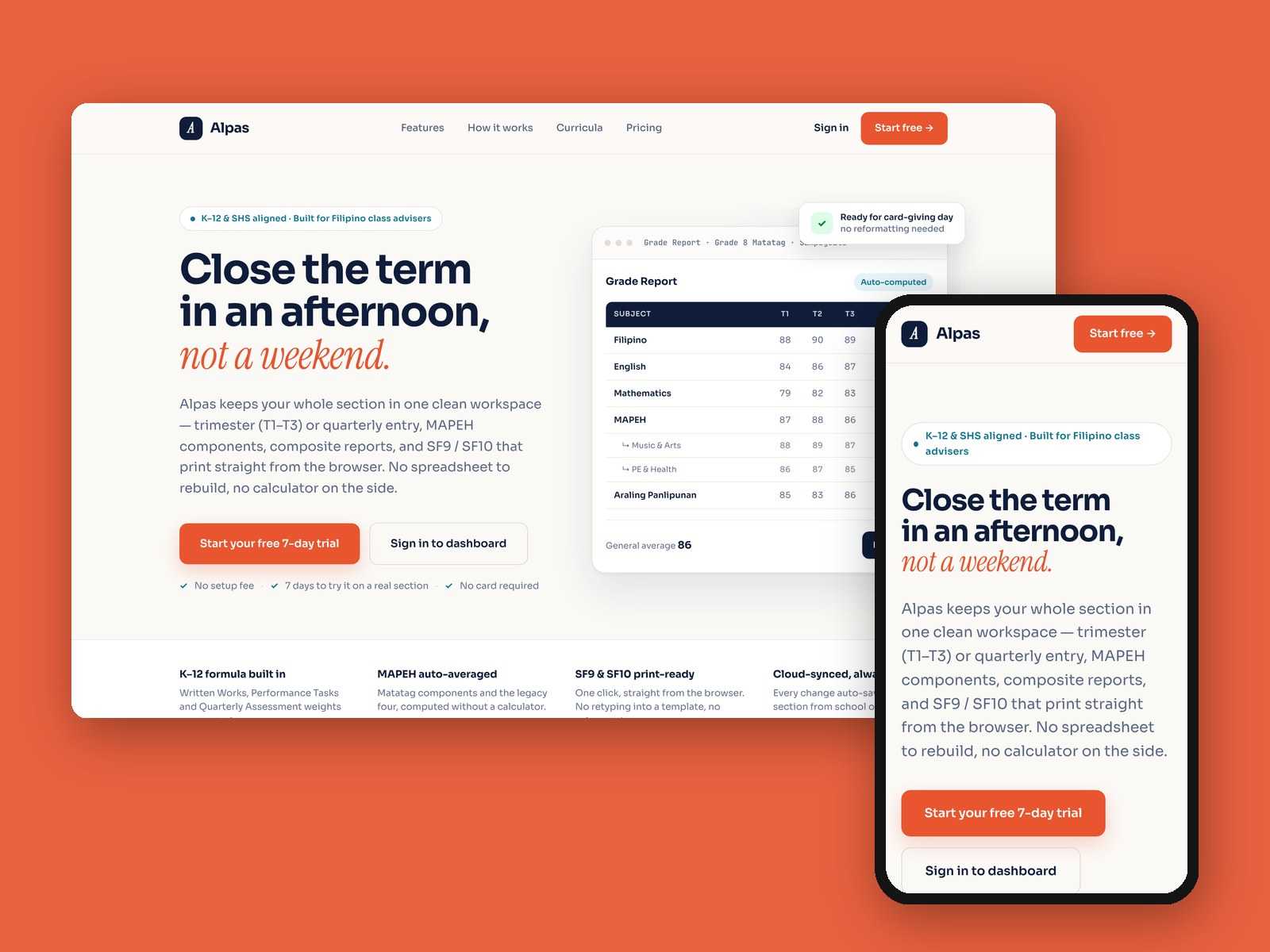
Class advisers collect grades from several subject teachers, average MAPEH components, compute composite and final grades, then retype everything into SF9 report cards and SF10 permanent records. A single mistake means reprinting.
With the shift to three grading terms in some grade levels, schools now run two grading models side by side, which makes the spreadsheets even harder to keep right.
WHAT WE BUILT
One workspace per section, from roster to report card.
Quarterly or trimester grading
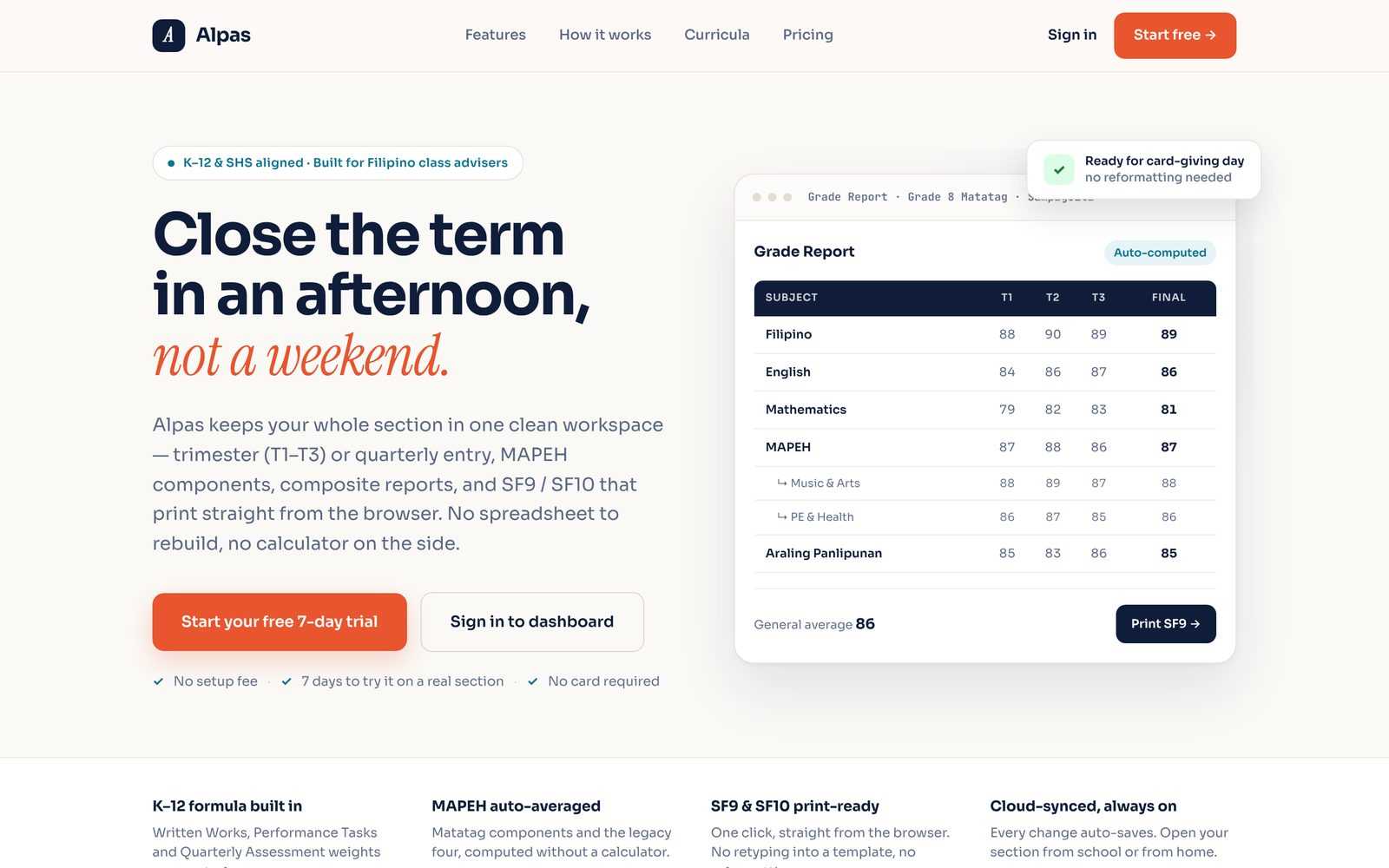
Grade entry for both the four-quarter model and the new three-term (T1–T3) model.
MAPEH and composites
MAPEH components are averaged automatically, and composite and final grades are computed for the whole section.
SF9 and SF10 in one click
Report cards and permanent records print straight from the browser, ready for card-giving day.
Subject teacher invites
Advisers invite subject teachers to enter their own grades into the shared section.
Local payments
Subscriptions paid through PayMongo with GCash, Maya or card, plus a 7-day free trial.
BIR-compliant invoicing
An admin back office that issues invoices and tracks payments for compliance.
A KEY DECISION
Do one job well.
Teachers already compute Written Works, Performance Tasks and Quarterly Assessment scores in their own class records, and the rules vary by school. Rebuilding every one of those formulas would have made the product slower to ship and harder to trust.
So AlpasGrade starts from each subject's final grade for the period and handles everything after it: component averaging, composites, final grades, remarks and the official forms. Keeping the scope tight let us ship a reliable core fast.
UNDER THE HOOD
How it's built
- App and authNext.js App Router with Supabase Auth; every route behind login is guarded by middleware.
- Data securityPostgres row-level security on every table, so teachers only ever see their own sections and students.
- PaymentsPayMongo payment links, with each webhook's signature verified before a subscription is activated.
- Invites and cachingUpstash Redis holds short-lived teacher invite tokens and caches hot reads.
- Documents and emailSF9 and SF10 generated as print-ready documents, with branded transactional emails through Resend.
Stack
- Next.js
- TypeScript
- Tailwind CSS
- Supabase
- PostgreSQL
- Upstash Redis
- PayMongo
- Resend
- Vercel
RELATED SERVICES